A Field and an Instrument
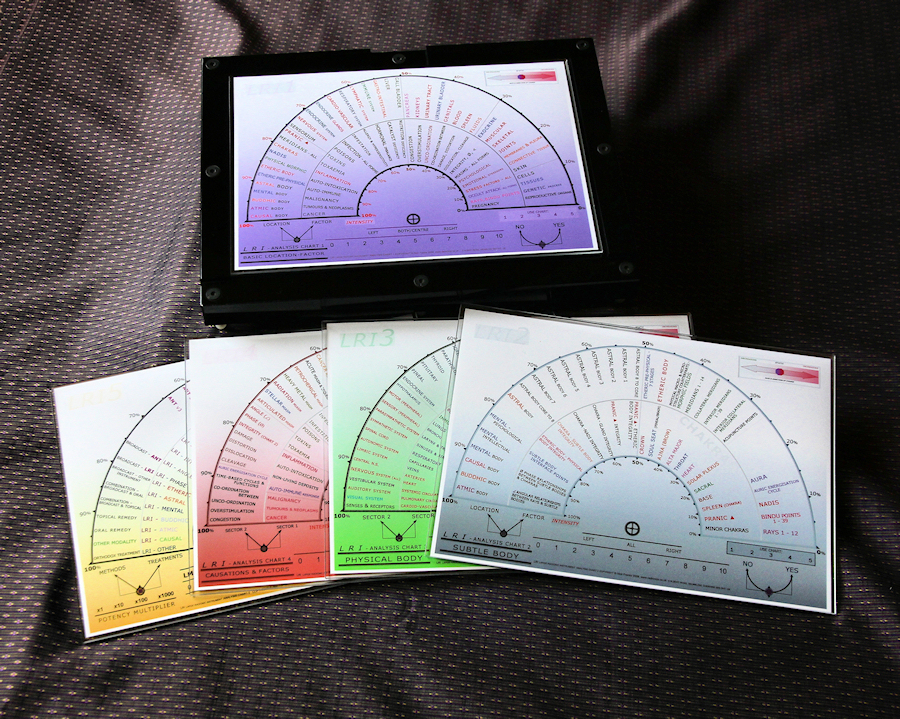
A Field and an Instrument On my desk sits the LRI-ULTRA (Large Radionic Instrument, developed by Nick Franks), its five large analysis charts spread across its surface in radiating lines and concentric arcs, hundreds of them, precise and intentional, printed in fine black ink on cream-coloured paper. Around it are all my radiesthetic tools: pendulums,…
A Field and an Instrument
On my desk sits the LRI-ULTRA (Large Radionic Instrument, developed by Nick Franks), its five large analysis charts spread across its surface in radiating lines and concentric arcs, hundreds of them, precise and intentional, printed in fine black ink on cream-coloured paper. Around it are all my radiesthetic tools: pendulums, dowsing rods, charts for yes-no and intensity readings. To one side, my computer runs the 3D design software from which I create the rates, cards, remedies, and physical instruments that form the other strand of my work. Off to one side of the instrument, inside a small plastic envelope, is a lock of someone's hair.
Nothing is plugged into the LRI-ULTRA. There are no batteries, no circuit boards, no radio transmitters. The room itself is shielded: no measurable electromagnetic fields reach this space from outside. What happens here happens in silence, without electricity and without magnets.
This is where I work.
The instrument beneath those charts was designed and built by Nick Franks, a British engineer, musician, and radionics practitioner whose work I have followed and studied for years. The five charts are its interface: they are how I ask it questions. The pendulum is how it answers. The hair sample is how it knows whose health we are discussing.
I am a radionics practitioner. I have spent more than thirty years with this material, first through study and then through practice. I live and work in the Valle del Lunarejo National Park in northeastern Uruguay, well off the grid, in a studio I built and shielded specifically so that nothing electromagnetic interferes with what happens here. I also build radionic instruments of my own: carved and assembled objects that are charged and programmed using the LRI-ULTRA, then sent to clients around the world who use them to maintain a continuous, coherent connection to the same subtle energy field the LRI-ULTRA addresses.
Why This Is Difficult to Explain
When I try to describe what I do to someone who has never encountered radionics, I often get a particular look. It is not quite scepticism and not quite politeness. It sits somewhere in between, waiting to see where this is going.
I understand that look. Twenty years ago I might have given it myself.
The difficulty is that radionics sits outside almost everything we have been taught to believe about how the world works. We live in a culture that has trained us, quite thoroughly, to accept only one model of what is real: the physical model. In this model, things happen because of physical causes. Energy moves through wires. Medicine works through chemistry. Distance is a barrier. If something cannot be weighed, measured, or observed with instruments that orthodox science recognises, then either it does not exist or it is not worth investigating.
Radionics violates every one of those assumptions.
In radionics, a practitioner in Uruguay can work with a patient in Germany, using a lock of that patient's hair as the only physical link between them, and produce effects that both the practitioner and the patient can observe. In radionics, remedies that have no measurable chemical content can produce clinical responses. In radionics, an instrument with no electronics, no magnets, and no power source can amplify and focus a practitioner's intention to a degree that years of unaided practice rarely achieve.
None of that is easy to square with the physics we learned in school. And yet it works. Not always, not automatically, and not in the hands of just anyone, but it works, consistently enough, and in enough cases across enough decades, that dismissing it as coincidence or suggestion requires more faith than accepting it.
The challenge for me as the author of this book is not to prove it to you. I am not going to try. The mechanisms by which radionics produces its effects are genuinely unknown, and anyone who tells you otherwise is either oversimplifying or speculating. What I can do is describe what I observe, explain the models that practitioners have developed to make sense of those observations, and give you enough of the working method that you can explore it yourself and form your own conclusions.
Before I Found This Studio
I spent twenty years at sea. Three sailing boats, all of them built by my own hands, and the oceans that separate Europe from the Americas and the Americas from each other. I was not a mystic at sea. I was a builder, a navigator, a mechanic. When something broke I fixed it. When the weather turned I sailed through it or waited it out. You learn a particular kind of thinking on a boat: precise, patient, interested in what is actually happening rather than what you expected to happen.
That thinking, I have found, is useful in radionics. Perhaps more useful than a theoretical background in physics or medicine would be, because it begins with observation and ends with action, without a great deal of attachment to the model in between.
I came to radionics through a personal health experience that orthodox medicine had addressed only partially. A friend suggested I look into it. I did. I found Nick Franks and his work. I ordered the LRI-ULTRA. When it arrived I read the manual three times before I touched it.
What I found, as I began to work with the instrument and to study the broader field it belongs to, was a discipline with a hundred-year history, a coherent internal logic, a rich body of clinical literature, and a community of serious practitioners who were, in the main, thoughtful and rigorous people. I also found that it worked on my patients in ways I could not dismiss.
That was enough. I kept going.
Eventually I left the sea, built the studio here in the Lunarejo valley, and started making instruments of my own: objects designed to hold and project the same kind of subtle energy field that the Nick Franks instruments work with, but in a physical form that a client can keep in their home, their office, or their garden. That part of the work grew into what is now Lunarejo Field Instruments, the second strand of what I do.
One thing I ask of every reader: come to this material with an open mind and a willingness to suspend judgement until you have tested it yourself. This is not a demand for credulity. It is the same stance you would bring to any serious investigation. Take it seriously. See what happens. Form your own view.
That is how I came to all of this. It is the only honest recommendation I can make.
This is an excerpt from At the Field's Edge: Radionics, Subtle Energy, and the Living Instrument by Peter Mican. Available on Amazon.
Questions about radionics or the instruments: studio@petermican.com